Wednesday, June 23, 2010

OnBoard Server is IFE Buffet for Passenger Personal Electronic Devices

Welcome to Wired!

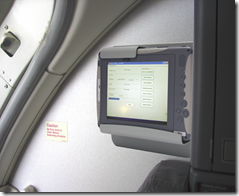
image Actually talking to someone is rarely at the top of the list of things people do with their smartphones, at least that’s the impression given by Pew Research Center studies. Adding tablets like the iPad, netbooks, and old school laptop computers to the mix of personal electronic devices (PEDs) people use to connect with the wired world, ASIG realized that most airline passengers today fly with the display half of an in-flight entertainment (IFE) system. It only seemed right to meet passengers halfway and install its OnBoard IFE server and access terminal in the launch customer’s Boeing 737 NG.

Traditional IFE systems, with screens wired into the back of every seat, are heavy, expensive, and impractical on many smaller single-aisle jets. And keeping pace with technology is an expensive decision because the server that feeds the seatback displays is permanently installed.

Powered by Avionica equipment, the OnBoard server/access terminal is based on tablet computer technology and size (10.5-by-7.2-by-1.65-inches). Easily removable, it is securely mounted in a lockable dock. Combined, the server and mount weigh just 9 pounds, and keeping pace with new technology is simply a matter of remotely and wirelessly pushing content updates or plugging a freshly updated server into the dock.

Part of ASIG’s Wired Aircraft architecture, OnBoard distributes its IFE content through a secure Wi-Fi router. To connect with the outside world, ASIG can configure it with the appropriate Iridium gateway and/or satellite communication system. OnBoard’s solid-state drive holds up to 800 hours of content, from streaming video to web hosting of online catalogs. With the Iridium gateway it will handle point of sale applications with real-time credit card clearing and text messaging. With satcom, OnBoard gives passengers text e-mail and SMS service.

image OnBoard can also reduce the time and money it takes to keep an aircraft mission ready by storing all the necessary manuals, databases, LRU operating software, and code images, making them immediately available to technicians. In conjunction with the backend server based avSYNC software, OnBoard uses its wireless routers to keep its IFE and maintenance content current.

Maintenance technicians can remove the server from its locked mount and take it to where they are working. In addition to a variety of digital documents and databases, OnBoard can deliver a number of support applications, including ARINC 615, ARINC 615A dataloading, ARINC 429 databus analysis, TCAS diagnostics, DFDR download, flight data analysis, and many more.

OnBoard’s new menu software enables operators to build custom prompts and workflows, from one-touch operation to detailed data entry. Combined with the system’s scalability, you can design the system best suited to your passenger’s needs and your bottom line.

OnBoard is the third and final phase of ASIG’s Regional Aircraft Cabin Improvement Program. An April 2010 STC marked the completion of Phase II, which provides external power for passenger personal electronic devices (See Major Amenities for Regional Cabins). Phase I, STC’d in January 2010, brought eight-meal TIA convection ovens to the EMB-145.

Combining an OnBoard IFE server and access terminal with ASIG’s external power supply system to the passengers’ personal electronic devices operating at full capacity will go more than halfway in making their flight productive and entertaining.

Until next time, stay 5x5, mission ready, and Wired!

Monday, June 21, 2010

Building Unique, Flexible STC Solutions

Welcome to Wired!

When bidding upgrades, most operators of transport-category aircraft look at deliverables and want to know the cost of four things: nonrecurring engineering, equipment, the kits that unite equipment and  airframe, and time and money it takes to consummate that union.

b727_09The answers to these questions define a  start-to-finish journey in four giant leaps, the categorical summation of the step-by-step route ASIG takes from the operator’s statement of work to installing the inaugural upgrade kit and shepherding it through certification. Optimized for efficiency and flexibility, each route is unique to the upgrade destination.

Each STC project has a unique list of documents that gives the FAA the data it needs for certification, says Managing Director Luke Ribich. ASIG builds a proprietary datalist with an application that compiles the necessary certification, manufacturing, and installation documents. Related applications compute the time and labor involved for each step, enabling ASIG to quickly answer the four main questions.

A full communication and navigation upgrade is a good example, says Ribich, because it has an involved document list, including the analysis of electrical load and system safety to weight and balance supplements. If the STC covers different aircraft, as an  all-model list (AML) would, an aircraft similarity report itemizes the applicable equipment. “More modern aircraft have a common nav pack or data bus,” but  classics like the Boeing 727-300 often have different electro-mechanical suites, depending on the initial operator. “That means more wire, different switches, and different boxes.”

A Service-Disabled Veteran-Owned Small Business (SDVOSB), ASIG assigns a highly experienced and proficient team of five to eight key employees to the prerequisite work that answers an operator’s four questions. They are the same people who make the plan happen once the deal is signed. An addendum to that agreement covers the kits, Ribich says, “because we can’t  price them until the engineering is done and the bill of materials is fully developed and bid out.”

ASIG always does the inaugural kit installation because it and any applicable ground and flight tests are part of FAA certification, which “goes extremely smooth when it’s a front to back, closed-loop program” handled by the same team. Once the STC is approved, ASIG drop ships kits to the operator.

ASIG will do phased installations, running cables and wiring on the first pass, and “ripping out the old hardware and dropping in the new on the second evolution,” Ribich says. ASIG will also work where the operator wants.

DC8_EFIS One of ASIG’s early projects proves this point and illustrates  its capabilities.  With  engineering liaisons and mechanics, a 22-person team turned a French Air Force DC-8-72 with a five-man cockpit  into an US-registered aircraft with with a three-man cockpit filled with 21st century systems. 

The to-do list was long: demilitarize the NATO equipment, install and certify a Universal EFIS with dual FMS, TAWS, and triple redundant RVSM digital air data system, as well as a cockpit voice and digital flight data recorders. “What made the project unique was the 10 pallet positions aft of the cockpit, followed by a 32-passenger combi section,” Ribich says. “A specialized flight director gave us some problems initially, but we designed and built a converter box that solved them.”

In a hangar the operator rented for the work, just big enough for the DC-8’s nose, the ASIG team brought everything it needed to install the new systems. Starting from scratch with a contract signed October 2005. all engineering was done the same day installations started, December 18. “We worked through Christmas Eve, were off through New Year’s Day, and completed all the work on March 28. The FAA issued the STC on March 12.”

Everyone at ASIG comes from the Part-121 world, Ribich says, “so we know it is a fast-paced environment that requires efficiency and flexible solutions.”

Until next time, stay 5x5, mission ready, and Wired!

Thursday, June 17, 2010

And the RAA Winners Are…

Welcome to Wired!

ASIG exhibited at its inaugural Regional Airline Association (RAA) Annual Convention in Milwaukee. All registered attendees (roughly 1,500) were automatically entered in our drawing, as were those who stopped by the booth, and it was good talking with all of you. Without further adieu, the winners are…

Grand Prize - Tom Tom Go 730 GPS

Tom Haarmann

Customer Service Manager—GoJet Airlines

Dry-weave Moisture Wicking Sport Shirt

Gwendolyn Bentley 

Purchasing Manager—Republic Airlines

John Cross

Director of Materials –Colgan Air

Joe Grogan

Director of IEP—Pinnacle Airlines

Rich Rupslauskas 

Technical Services—Air Wisconsin

Ron Charles

Senior Director, DIA—Frontier Airlines

Terry Basham

Vice President, Customer Service—Trans States Holdings

Port Authority Moisture Wicking Golf Visor

Todd Hargrove

HazMat Senior Specialist--Southwest Airlines Company

Jimmy Owenby

Station Manager—SkyWest Airlines

Joe Williamson

Diversified Communications Group

Mike Lohmann

Training & Standards Director—Jazz Airlines

Randy E. Tweed

Chief Inspector—Commutair

June Donovan

Security Manager—JetBlue Airlines

Cindy Grzyb

General Manager—Continental Airlines

Thomas Reynolds

GM, Maintenance Operations—Atlantic Southeast Airlines

Lo Lyons

In-Flight Training Manager—ExpressJet Airlines

Until next time, stay 5x5, mission ready, and Wired!

Tuesday, June 1, 2010

PMA Parts Make Improvements Possible

Welcome to Wired!

Any aircraft is the sum of its parts, and if any one of them is not designed, tested, and approved for use on a specific make and model, the airplane cannot legally earn its keep. Airframe and powerplant OEMs are the primary source of approved parts, but usually they do not accommodate capabilities beyond those that existed when the aircraft earned its type certificate.

PMA FLowchartIncorporating new technology after an aircraft earned its TC requires a supplemental type certificate (STC). And the parts that bring everything from glass cockpits and NextGen avionics to cabin in-flight entertainment systems earn their right to fly through the Parts Manufacturing Approval (PMA) process.

As the PMA flowchart suggests, it’s an involved process. Often it starts with an approval from an Aircraft Certification Office (ACO). Most STCs involve major changes to an airplane’s capabilities, and the FAA requires proof that they do not adversely affect the airplane. As part of its STC efforts, ASIG  works with the necessary FAA offices.

Developing PMA parts not only makes STC’d  improvements possible, it creates the parts that maintain the new capabilities. ASIG engineers design needed parts as they develop an STC, but their work goes well beyond laying out an instrument panel or  wiring harness that connects it to the airplane. In transport-category aircraft each new part must meet the requirements of Part 25. In other words, the new part must be equal to—or better than—the part it replaces.

A new part proves itself through drawings, specifications, and documents that include all required computations and the results of an exhaustive testing plan. To be eligible for installation the part must be made of the appropriate materials. It must perform its intended function and be compatible with the parts or components to which it is connected. Tests must prove that the part performs reliably under all mission profiles, cyclic loads, the stress of pressure and temperature, and all other applicable operating conditions.

From this design and testing work ASIG creates the required plan for continued operational safety (COS). Central to this effort is determining how critical a part is by assessing the consequences of its failure. Starting with the part’s fatigue life, engineers apply the appropriate margin of safety by establishing its airworthiness lifespan. Further, they identify failure modes, provide corrective actions, and generate instructions for continued airworthiness. And they include a recordkeeping plan that starts when the part is manufactured and legibly numbered with permanent markings. 

An FAA Manufacturing Inspection District Office (MIDO) examines every scintilla of a PMA application. This can be time consuming, but ASIG’s designated engineering representatives approve much of the work before it goes to the FAA, significantly reducing the time to the MIDO’s final approval—and the time it takes to introduce new capabilities to your fleet.

Until next time, stay 5x5, mission ready, and Wired!

Friday, May 14, 2010

NextGen Now an Important Part of Aircraft Buying & Selling Decisions

Welcome to Wired!

Deciding to buy or sell an in-service transport-category aircraft is a process that employs a calculus of variations to assess myriad values. There are hundreds of them, from cycles and hours remaining on life-limited components and systems to fleet compatibility, maintenance training, spare parts, and required documentation on things like Standardized Wiring Practices, which includes EWIS, electrical wiring interconnection systems (another area of ASIG expertise, by the way).   

Airliner for sale Add a new variable: the NextGen National Air Transportation  System. Really. After years of talking and testing, the time has come to get serious  about  upgrading to  performance-based navigation systems that deliver the required navigational performance because “tomorrow” is here. And  travelers know it’s coming, thanks to articles like “Overhaul Lies Ahead for Air Traffic Control,” which recently ran in Cincinnati.

The satellite-based Automatic Dependent Surveillance-Broadcast (ADS-B) system now tracks aircraft over the Gulf of Mexico and Louisville, and it is coming online in Juneau and Philadelphia. But that’s just the start. “By 2013, satellite-based surveillance will be available to equipped operators nationwide [emphasis added],” writes FAA Administrator Randy Babbit.  

Naturally, work on NextGen will continue beyond 2013 as the government redesigns the airspace to match the new satellite-based systems. But the administrator’s words are also an unspoken warning: aircraft not equipped for NextGen airspace will go to the end of line for ATC services, a position that will match their standing with their competition—and consumers.

Why buy or sell an aircraft in this time of transition? Because upgrading some aircraft is easier and more economical than others. And as airlines like Southwest have proven, a homogenous fleet, which cuts the cost of upgrades, spare parts, and maintenance, makes an important contribution to overall success. (See Fleet Upgrades Share Rewards--and Costs.)

Whether you are buying, selling, or both, ASIG's Fleet Planning & Support staff are masters of complex calculus, working all of the financial, regulatory, and operational variables in custom computations founded on clearly defined operational requirements. The results are decisions that deliver the best return on an investment in NextGen capabilities. 

Airplane lot Beyond a comprehensive analysis of cost versus configuration, ASIG can handle the entire process for buyers and sellers,   reliably completing every task quickly and correctly. Tasks range from finding appropriate aircraft and thoroughly evaluating it before the purchase to performing or managing all of the maintenance, upgrades, conversions, and standardization work that makes it a member of  your fleet after the deal is done.

To start calculating how you will efficiently and economically build a fleet that will take full advantage of Next Generation National Air Transportation system, contact ASIG. You can start face-to-face at the Regional Airline Association (RAA) 2010 Convention, May 24-27, at the Frontier (formerly Midwest)Airlines Convention Center in Milwaukee, Wisconsin. Look for us in Booth 631.

Until next time, stay 5x5, mission ready, and Wired!

Monday, May 3, 2010

Major Amenities for Regional Cabins

Welcome to Wired!

EMB-145 Cabin To the traveling public the hours spent strapped in a jetliner’s seat are the same whether they are in a big Boeing or Airbus or a regional jet like the Embraer EMB-145. In this confined world, what makes or breaks a flight are the amenities—or their absence. 

Cabin services are what separate regional from major carriers—until now. ASIG earned a supplemental type certificate (STC) in April that adds a power supply for passenger personal electronic devices (PEDs) to the EMB-145. It completes Phase II of  ASIG’s three-part program that upgrades regional cabins with major amenities.

Rare is the passenger who doesn’t carry at least one PED. Ranging from smart phones and netbooks to tablet computers (like the new iPad) and full-size laptops, business travelers often carry more than one—and they all need power. With the ASIG PED power supply STC, the launch customer can now deliver it.

AS3112-Plug ASIG built its system using  Astronics AES Empower units, which includes FAA-approved sockets on the lower sidewalls that accept plugs from 145 nations. Passengers simply plug in their PED’s AC converter. Serving up to 50 passengers, the system can be divided into as many as 12 zones. The custom ASIG control panel (with fault indication) manages the zones individually, allowing operators to monetize the service.

Regional carriers that energize and recharge their customers will  have the edge because market research shows that they are flying longer routes for their major airline partners,” says Luke Ribich, ASIG’s managing director. Using himself as an example, regionals deliver him to the hubs surrounding ASIG’s home in Little Rock, Arkansas, and “it’s an hour to Dallas, two hours to Houston, and almost three hours to Atlanta.”

Before giving passengers uninterrupted power, ASIG’s regional cabin improvement program brought them hot meals. In January 2010 it earned the STC that installed  TIA convection ovens  in the launch customer’s  EMB-145s. It is now selecting equipment, completing the certification plan, and reviewing the final details with the launch customer for Phase III, a cabin IFE server that will Wi-Fi music, movies, and other entertainment  to PED web browsers.

cabin-wifi

“Installing a full blown in-flight entertainment system in a regional jet is not cost effective,” Ribich says. But the opposite is true if the passengers bring their own screens. “Smart phones will lose their 3G signal at 10,000 feet, but like any Wi-Fi device, from portable games to laptops, when you open the web browser it’ll look for—and find—the cabin Wi-Fi enabled server.” 

Satellite-based Internet access is a Phase III option, as is the credit card screen that appears when passengers log into the cabin entertainment server. The server will download the billing information to the airline’s accounting system after landing, Ribich says.

Phase III should be completed by the end of 2010, and ASIG is in the process of adding the 37-seat EMB-135 and 44-seat EMB-140 to its Phase I and II STCs. Individually or combined, each regional cabin amenity will set that flight apart from the rest in minds of passengers. 

Until next time stay 5x5, Mission Ready & Wired!

Wednesday, April 28, 2010

Video Gives Life to ADS-B Benefits

If a picture is worth a thousand words, a video that clearly animates the benefits of the ADS-B system is surely worth the thousands of tiny-type pages that describes the system’s operational benefits.

This video, produced by EurocontrolTV, brings ADS-B’s time-and-money-saving benefits in non-radar areas to life. The system is now providing these benefits over  the Gulf of Mexico and Philadelphia. And it will soon be coming to airspace near you.

Until next time, stay 5x5 and Wired!