Wednesday, September 8, 2010

Aging Aircraft Safety Rule Deadline, Fatigue-Critical Structures & ASIG

Welcome to Wired!

In medicine, the guiding principle is “First, Do No Harm.” In other words, treating the malady is not supposed to adversely  affect the patient’s immediate health or long-term quality of life.

737 Convertable A similar rule will soon affect Part 121 and 129 operators. At the heart of the Aging Aircraft Safety Rule (AASR) is the requirement that the repair, alteration, or modification of fatigue-critical structures does not affect airframe integrity and safety. To ensure this outcome, by December 20, 2010, operators must have in place a maintenance program based on the airframe’s damage tolerance.

“Aging,” however, is a misnomer. AASR affects every US-registered airplane in 121/129 service that was delivered before the December 20, 2010 deadline. Whether you’re flying a venerable DC-8 or a 777 that was delivered yesterday, AASR applies to you. At best guess, it affects roughly 4,000 airplanes and 240 operators. (That number could more than double if Transport Canada and EASA decide to adopt its requirements.)

In the FAA dictionary, a fatigue-critical structure “is susceptible to fatigue cracking that could contribute to a catastrophic failure.” This includes structures that become susceptible to catastrophic fatigue cracking due to alteration or repair.

ASIG has built considerable knowledge of and experience with  AASR requirements and processes through years of STC work.  Since  January 11, 2008, the rule has required that STCs include damage tolerance inspections of fatigue-critical structures. It has made the same requirements for new or revised repair and master-change service bulletins. The point is that regardless of how the information is delivered, STC or service bulletin, the essential process for acquiring the necessary data is the same.

 Advisory Circular 120-93, Damage Tolerance Inspections for  Repairs and Alterations, provides the necessary guidance. To comply, by December 20 operators must reassess their structural maintenance programs and how they handle repair approvals. They must survey all active airplanes and document what existing  repairs, alterations, and modifications require damage tolerance inspections. Compliance might sound easy, but it requires complex process and procedural changes and revisions to existing maintenance programs.

In the FAA dictionary, an “existing” repair, alteration, or modification will have been performed before December 20, 2010 on a fatigue-critical structure not already covered by a damage tolerance evaluation and resulting inspections.

B727 The survey and evaluation process starts with an “as-delivered” aircraft, with  OEM supplied documents setting the baseline.  These documents define and list fatigue-critical structures and include updated damage-tolerance maintenance data in repair manuals and in  fleet and master-change service bulletins. STC holders, such as ASIG, provide baseline data for applicable modifications.

The Operator Implementation Plan (OIP) is built on the foundation of baseline data. It includes a timeline for such milestones as completing the fleet survey, determination of damage tolerance inspections, and accomplishment of those first inspections. The OIP is due by December 20, 2010, and the operator’s FAA principal maintenance inspector must review and approve it.  ASIG’s leadership team has its foundation in air carrier engineering management.  Their efforts have led to the derivation of a variety of FAA accepted procedural compliance programs supporting airframe “thumb-printing,” specifically those tracking, detailing and analyzing damage tolerance.   Damage tolerance programming and DTA show-compliance determinations are at the very core of ASIG’s Structural DER cadre.

Once the OIP and the individual airframe applications are approved, the work continues after the deadline as operators follow their OIP to compile their damage tolerance data and revise their maintenance programs that sustain fatigue-critical structures and airframe integrity.

ASIG extends its sincere thanks to thanks to Mr. Mike Gray of Sun Country Airlines for suggesting we address this industry critical topic.

Until next time, stay 5x5, mission ready, and Wired!

Monday, August 16, 2010

ITAR & Exporting Aviation Technology

Welcome to Wired!

Aviation is an industry with global reach and international relationships, but national borders still matter, especially when it comes to US aviation technology. For use beyond America’s shores it must be properly licensed under the International Trafficking in Arms Regulations (ITAR), established in 1976 to improve national security.

If you’re wondering what this has to do with aviation, peruse the United States Munitions List. On page 39, under Item 9—Category II, you’ll find “instrumentation, navigation, and direction finding equipment,” which includes “integrated flight instrument systems.”

00010000008A

Item 10—Category II covers “Flight Control Systems” and its technology, including the “integration of the flight control, guidance, and propulsion data into a flight management system.”

And Item 11—Category II covers “Avionics,” with special interest in radar and laser radar systems (including altimeters), GPS, and systems capable of terrain mapping.

All of these systems can be easily modified to fly an unmanned aerial weapon to its target, says Luke Ribich, ASIG’s managing director, so the government likes to keep track of them.

It starts with the State Departments’ Directorate of Defense Trade Controls, keeper of the Munitions List. Another important player is the US Commerce Department’s Bureau of Industry and Security, which publishes the Commerce Control List. Intimately connected to multinational agreements and international relations, the CCL changes frequently.

labyrinth touch The point, Ribich says, is that export requirements for aviation technology is a complex regulatory labyrinth, and the penalties for taking a wrong turn can be expensive, often measured in seven figures, with jail time. Things have gotten even more serious since 9/11.

Earning and maintaining an export license is a substantial investment, Ribich says. Given its complexity and consequences,  it demands the full attention of dedicated resources. That’s fine for companies like ITT, Lockheed Martin, and Northrop Grumman, and ASIG, but an operator who periodically needs this expertise, not so much. 

Serving operators worldwide, ASIG maintains its export license as part of its comprehensive menu of engineering and certification services. By drawing on this international expertise for out of the ordinary projects, operators can focus on the demands of their daily operations, Ribich says. “Export can be easily done,” he continues, “if you’re set up with a State Department-approved ITAR-licensed export program.”

With many transport category aircraft owned by international leasing companies, export regs are important considerations. Giving an example, Ribich says several years ago a US operator sold its N-registered aircraft to an overseas company who, in turn, leased them to an European operator who registered them in its homeland.

“The leasing company is now leasing them back to the original owner,” and ASIG is reconfiguring them to the new (original) operator’s standards, taking care of all the government approvals so they will be FAA-approved when they return to America.

“We didn’t have any ITAR items in that project,” Ribich says, but ASIG knows that because it checked every system against the applicable regs. When it comes to national security, the government isn’t known for a lenient sense of humor, and ignorance is no excuse for not complying with the requirements.

Until next time, stay 5x5, mission ready, and Wired!

Wednesday, August 4, 2010

The Best of AirVenture Oshkosh 2010

Welcome to Wired!

EAA AirVenture Oshkosh is America’s annual cornucopia of aviation. Drawing all segments of the industry, it is the premier stage on which to debut new products and report the progress of innovations under development. Many things captured our attention, and the following made our Best of AirVenture list.

GE Aviation & Electric Aircraft

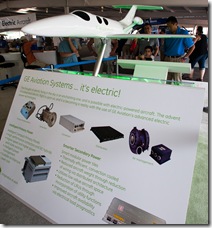
AV5-052 GE Aviation sponsored the inaugural Electric Aircraft Symposium, on July 30, and the Aviation Learning Center, home to related exhibits.  When it comes to transport category aircraft, electric propulsion is not yet practical, but it’s perfect for  aircraft systems because it  replaces “big and hot with small and cool,” GE Aviation President Chet Fuller told the roughly 300 participants.

With its generators producing 1.4 megawatts, the Boeing 787 is aviation’s first electric airplane, right down to anti-icing, he said. It replaces  pneumatic and hydraulic systems, which leak, and eliminates bleed air systems, explaining that heat and composites do not go well together.  Looking to the future Fuller said smart grids would deliver electricity without waste, variable frequency power would eliminate AC and DC systems, and that fuel cells would eventually replace wasteful APUs.

Sikorsky Innovations Preparing Electric Firefly

AV5-042 The technology development arm of its parent company, Sikorsky Innovations debuted Project Firefly, an electric powered helicopter. A a high-efficiency U.S. Hybrid electric motor and digital controller drives the S-300c’s stock rotor and transmission. Side-mounted Gaia lithium ion energy pods  provide the power. Approaching its first flight, the Firefly’s initial endurance goal is 15 minutes, said Sikorsky Innovations Director Chris Van Buiten. Upcoming flight tests will prove the system’s reduced complexity, noise, maintenance, and vibration. With no carbon footprint, it will deliver full power at altitude. This research will likely spawn new systems, he said, like an electric anti-torque tail rotor, which  promises numerous power, noise, and vibration benefits. 

Aspen Avionics Geo-referenced Charts

Evolution_georef_ChartDataAspen Avionics, working with Seattle Avionics Software, a software developer and data provider, has introduced geo-referencing  on its Evolution EFD1000 and EFD500 multifunction displays (recently approved for Class III aircraft, which weigh 6,000-12,500 pounds). Besides displaying the aircraft’s relative position on AeroNav (formerly NACO) instrument approach charts and airport diagrams, this new capability comes at no cost, other than a  database subscription. When users load the the July 28 Seattle Avionics chart update it automatically upgrades their systems with the new capability.

Avionics & Autopilots Act When Pilots Distracted

When multitasking in complex instrument airspace, single pilots can easily get distracted from their primary job of flying the airplane. Two avionics OEMs are addressing this problem from different angles.

Avidyne's DFC90 autopilot now offers speed-based Flight Envelope Protection. Currently, it’s STC’d for Cirrus SR20 and SR22 piston singles with Avidyne’s Entegra avionics system and S-Tec55X autopilot. With the autopilot engaged, it provides aural and visual warning when nearing high and low-speed parameters. If the pilot does not act, the DFC90 adjusts the pitch to maintain a safe speed while continuing to issue its warnings.

Garmin's Electronic Stability and Protection (ESP) System  maintains safe and stable flight when the autopilot IS NOT engaged. Driven by G1000 and G3000 avionics, ESP monitors attitude and airspeed—and tells the autopilot servos to make corrective pitch and roll inputs when the aircraft approaches unsafe attitudes and airspeeds. Recoveries are programmed to not exceed airframe g-limits.

AeroLEDs Frugally Bright Landing & Nav Lights

AV6-076 Amateur aircraft builders have been using LED aircraft lighting for some time. In 2007, AeroLEDs produced the first all LED nav/strobe system that meets the requirements of TSO C30C and C96a-C2, giving operators of certificated aircraft access to the reliable lights that use up to 80 percent less power than their incandescent counterparts. Just joining the landing light line is the SunSpot 64, a 35-ounce unit that produces 17,000 lumen on 224 watts and 8 amps at 28 volts.

New iPad EFB Applications

Jeppesen has introduced its Mobile TC application that searches and views terminal charts. Subscribers to JeppView get iPad access at no extra charge. Seattle Avionics Software is providing its ChartData to four new iPad apps: Flight Guide’s iEFB; Hilton Software’s WingX; Radenna’s SkyRadar; and Zivosity ‘s Beacon North America.

Until next time, stay 5x5, mission ready, and Wired!

Thursday, July 29, 2010

ASIG Tells the Rest of IFE Story

Welcome to Wired!

A recurring news story is the investment major airlines are making to upgrade the cabin amenities in their fleets. This CBS News report shows the benefits of power supplies for passenger electronic devices and seat-back in-flight entertainment screens. But like most such news stories, it ignores regional carriers and operators of smaller aircraft who are providing similar amenities to their  passengers with ASIG’s EmPower supplies and OnBoard IFE system.

The reporter notes that the seatback IFE system allows parents to control what their children see during the flight. With the OnBoard system, passengers need not invest the time to learn and input the parental settings in the seatback system because they  enjoy the IFE options on their personal electronic device, which is already configured to their particular needs.

For the rest of the story, see OnBoard Server is IFE Buffet, Major Amenities for Regional Cabins, and contact ASIG.

Until next time, stay 5x5, mission ready, and Wired!

Thursday, July 22, 2010

Log-In to VESSA™ for Cost-Efficient Engineering

Welcome to Wired!

Optimizing productivity and controlling cost is important in any economy. Machines—and the people who operate, maintain, and keep them current—must be engaged in  productive effort most of the time. Make work need not apply.

VESSA-FULLIn aviation, some efforts are periodic or unpredictable, and staffing for them is contrary to efficiency’s goals. To satisfy an operator’s needs when they arise,  enterprising companies have developed cost- efficient solutions that go by many names, power-by-the-hour,  NetJets—and VESSA™, aka ASIG’s Virtual Engineering Services Subscription Agreement.

With almost every aspect of certification and airworthiness hinging on approved data, engineers are essential members of the aviation team, says Luke Ribich, ASIG’s Managing Director. When an unexpected workload or large project stretches the limits of the subscriber’s staff, VESSA™ provides immediate relief by allowing the subscriber to tap into ASIG’s full service engineering and certification expertise for as long as is necessary to eliminate the engineering overload and return to business as normal.

Launched in 2007, VESSA™ has served nearly 30 subscribers to date, each with a dedicated portal available from any computer with Internet access. ASIG maintains the servers—and security—which meets the requirements of an especially picky subscriber, the Department of Defense.

RolloverMom A typical subscription runs three years, and companies can adjust their  engineering requirements up or down annually. ASIG also offers “an AT&T provision,” Ribich says, referring to the  TV commercial where the mother admonishes her son for discarding his rollover minutes. “In other words, the engineering effort unused in any given month carries forward…so if you have a month that runs over, you’re not losing anything.”

Cash flow forecasting is another VESSA™ strong suit. If subscribers have an upcoming “program, like the CNS/ATM requirements coming down from NextGen, they can amortize the cost over the  year,” Ribich says. “Likewise, if their fleet changes or they need to reduce costs for some reason, they can make those adjustments at the end of each 12 months.”

Engineering is document intensive, so VESSA™ is an online library that enables subscribers to quickly find and use them, printing hardcopies as needed. Subscriber-provided  documents, from tech orders and diagrams to illustrated catalogs and ICA, are determined when setting up the subscription or project, and ASIG can digitize anything not already in electronic form.

VESSA PORTALSubscribers initiate projects by uploading the scope of work, and the system captures all online collaboration with ASIG’s engineers. Other pages present the project’s Gantt charts, milestones, any required photos and video, contact information for everyone on the project, links to viewers needed to examine data files and drawings, invoicing, a weekly status report, the engineering help desk, and many more features.

VESSA™ also works well with first-article and proof-of-concept manufacturing, Ribich says. And it’s all on-call, 24/7/365. Being online, its on-demand operation enhances efficiency. If a last-minute schedule change prevents a subscriber from reviewing a document for approval or changes, the task—not a roomful of people—waits for him without complaint—or loss of productivity.

Until next time, stay 5x5, mission ready, and Wired!
Tuesday, July 6, 2010

EWIS, EZAP & ICA: What’s It All Mean?

Welcome to Wired!

Two new acronyms have recently joined the aviation lexicon, EWIS (electrical wiring interconnection system) and EZAP (enhanced zonal analysis program). Both are intimately related to ICA (instructions for continued airworthiness).

EWIS was conceived on July 17, 1996, when TWA Flight 800 fell into the Atlantic 12 minutes after its New York departure. During its four-year investigation the NTSB never found what ignited the 747’s center wing tank,  but it did find a number of potentially unsafe conditions nearby, including cracked insulation, open-ended  splices vulnerable to moisture, and other repairs that didn’t comply with Boeing’s Standard Wiring Practices Manual.

AC Insp This discovery led to the FAA’s Aging Transport Systems Rulemaking Advisory Committee (ATSRAC). Composed of airlines, OEMs, and regulators, it inspected 81 aircraft, finding 3,372 discrepancies. They ranged from deteriorated wiring, corrosion, improper installation and repairs to contamination by metal shavings, dust, and flammable fluids.

The arcing IFE cables that likely brought down Swissair Flight 111 on September 9, 1998 reinforced the ATSRAC mission. After the Lear 35 carrying golfer Payne Stewart crashed in 1999, the NTSB urged the ATSRAC to look at all transport category aircraft. While the NTSB found no specific cause for the loss of pressurization, the system is controlled electrically.

Until this time, wiring rarely received any special maintenance or inspections, even though its failure causes delays, unscheduled landings, IFE system problems, and both nonfatal and deadly accidents. The ATSRAC recommended internationally harmonized certification requirements, standard wiring practices, and maintenance procedures to correct and prevent these consequences.

These recommendations led to NPRM 05-08, Enhanced Airworthiness Program for Airplane Systems/Fuel Tank Safety. Published on October 6, 2005, it christened EWIS and, for the first time, officially defined the electrical system and gave it a home, Subpart H of Part 25. The point is that safety depends on the reliable transfer of electrical energy, and that EWIS is equal to the critical systems it connects and controls.

Officially, EWIS is “any wire, wiring device, or combination of these, including termination devices, installed in any area of the airplane for the purpose of transmitting electrical energy, including data and signals, between two or more intended termination points…. This includes electrical cables, coaxial cables, ribbon cables, power feeders, and databuses.” Don’t think wires, think wiring diagram. EWIS covers everything a mechanic can maintain, repair, or modify.

The final rule (dated December 2007, with compliance starting 39 months later) bred dozens of advisory circulars. AC 25,17001-1, Certification of Electrical Wiring Interconnection Systems on Transport Category Airplanes, guides the creation of the original system and its modification by companies like ASIG. A third of its guidance pages is dedicated to the qualitative and quantitative safety assessment and analysis required for original and  supplemental type certification.

wireties-3  AC 25.27-A, Development of Transport Category Airplane Electrical Wiring Interconnection Systems Instructions for Continued Airworthiness Using an Enhanced Zonal Analysis Procedure, is the everyday bible. OEMs add EWIS (including electrical load data) to the ICA for an as-delivered configuration. Subsequent modifications, like ASIG’s OnBoard IFE server, must seamlessly integrate their ICA with the OEM’s.

Operators incorporate the new instructions with an EZAP, which determines the appropriate inspection and cleaning procedures. Simply put, mechanics evaluate EWIS’s condition and the affect of nearby items, such as plumbing or control cables, to its safety. An EZAP is a logical addition to aircraft covered by a zonal inspection program. On non-ZIP aircraft the EZAP will identify EWIS-related tasks that must be consolidated in the inspection and maintenance programs. (Those who hold the design approval for these aircraft may find it worthwhile to create a ZIP in conjunction with an EZAP).

Ultimately, OEMs, STC holders, aircraft operators, repair stations, and anyone who provides maintenance need to evaluate their overall philosophy and specific maintenance tasks so that EWIS receives the same care and attention as any other system critical to aircraft operation.

Until next time, stay 5x5, mission ready, and Wired!

Thursday, July 1, 2010

Airlines Upgrading Cabin Amenities

Welcome to Wired!

A recent Wall Street Journal article and video reported that a number of major US carriers are upgrading their coach cabin amenities with “better entertainment systems, Wi-Fi access, [and] more electrical outlets.”

American Airlines, as the article and video show, is upgrading its Boeing 737 fleet, replacing the old IFE system with flat-panel LCDs, power plugs, and Wi-Fi. Continental is adding power plugs to some of its aircraft, Delta is putting video on its international fleet, and United is adding video and power plugs to many of its Boeing 777s.

ASIG can help you keep pace with its OnBoard IFE server (See OnBoard Server is IFE Buffet for Passenger PEDs) and EmPower passenger PED power supplies (See Major Amenities for Regional Cabins).

Until next time, stay 5x5, mission ready, and Wired!