Wednesday, November 16, 2011

Waiting for NextGen: Possible Progress

Welcome to Wired!

When it comes to developing and implementing the Next Generation Air Transportation System, there is no chicken or egg quandary when listing the impediments it must overcome. Technical challenges and industry acceptance and integration follow the political process that allocates the funds that make the project possible.

Congress has punted the long-term FAA reauthorization bill nearly two dozen times, stalling NextGen progress. But that could change by Christmas, reported the Daytona Beach News-Journal. John Mica, chairman of the House Committee on Transportation and Infrastructure predicted that a long-term FAA funding bill would be under the tree, ready for the president’s signature.

NextGen Testbed OpeningMica and his committee met at the Daytona Beach of Embry-Riddle Aeronautical University in mid-November to open the renovated NextGen Test Bed. One of three such facilities (the others are the FAA Tech Center in New Jersey and a NASA facility near DFW), it develops and tests NextGen technology. Equipped with ADS-B in 2003, ERAU’s training fleet of 64 aircraft log roughly 65,000 hours a year, enabling real-world end-to-end evaluations of NextGen systems.

Doubling the facility’s space to 10,000 square feet, the renovation prepares the site for its third phase, working toward, among other things, a 300-percent increase in traffic through the use of continuous ascent and descent procedures. Phase II was dedicated to integrating airport surface monitoring and arrivals and departures into SWIM, the system-wide information management system. Phase I, begun in 2008, focused on 4D weather and trajectory display systems for air traffic controllers.

Svc MapDespite the impediment of unpredictable funding, the NextGen team has been making progress with its available resources. Its website presents a map that lists the progress made at airports nationwide. And earlier this year, the FAA and European Union signed an agreement for joint research that ensures NextGen with the Single European Sky ATM Research (SESAR) compatibility and interoperability of avionics, communication protocols and procedures, and operational methods. In other words, seamless air traffic service to aircraft flying between the US and Europe.

Until next time, stay 5x5, mission ready, and Wired!

Thursday, October 13, 2011

ASIG Establishes Military Advisory Board

Welcome to Wired!
In life and in business, especially in the 21st century, two essential realities are that no one has all the answers and success depends on efficiently and economically meeting a clearly defined real need. To further these principles in products developed for the  Department of Defense projects, ASIG has formed a Military Advisory Board
Composed of five to seven  officers retired from all branches of the military, each will commit to a three-year term to provide continuity. The MAB’s mission is to mentor and provide focused, confidential feedback to ASIG’s management team in a two-step process:
First, ASIG will brief the MAB members on a proposed product development program. Comprehensive and appropriate to the product, it will include everything from notational designs and functional, operational, and software specifications to sales and marketing materials delivered in print and digital mediums, and in-person at trade events.
The MAB will give its feedback through a confidential survey. Based on the members’ vast and varied military experience, each of member will assess how well the product will serve, support, and benefit the intended user and mission. This includes applicable logistics, strategic/tactical employment of technology, ergonomics, durability, ease of maintenance, process improvement, and other appropriate factors. It will also provide similar feedback on the sales and marketing materials.
Retired Air Force Major General James L. Hobson (above) has accepted the chairmanship of ASIG’s Military Advisory Board. A command pilot with more than 6,500 hours in numerous fixed and rotary-wing aircraft, he led the Air Force Special Operations Command until his retirement in 1997. He holds post-graduate degrees in systems management and international studies from USC and the Naval War College, and Harvard University’s senior executive program in national and international security.
Joining him are Colonel Richard Shurtleff and Colonel Len Friedlander, both retired U.S. Air Force, Colonel Kennon Hines, who retired from the U.S. Marine Corps, and Navy Reserve Captain Steven Schellberg.
Col. Shurtleff is an Air Force Academy grad, a command pilot with experience in materials, logistics, and information technology. Col. Friedlander has dedicated his military and subsequent private sector career to information technology and its management. A former Blue Angel, Col. Hines has extensive experience in aeronautical engineering, R&D, and media relationships. A graduate of and senior flight instructor at the US Navy Test Pilot School, Capt. Schellberg specializes in all aspects of rotary-wing engineering and fight.
Until next time, stay 5x5, mission ready, and Wired!

Tuesday, September 27, 2011

Power Conditioning Keeps EFBs Cool

Lithium batteries power the portable electronic devices that make life more enjoyable and work more efficient. Just ask any pilot with an iPad Electronic Flight Bag (EFB). But these rechargeable power sources have a dark side. When they lose their cool, a  thermal runaway threatens everything around them. 

Given the battery’s size, how bad could the risk of fire, explosion, and toxic fumes be? Consider the following, and remember that regardless the source—external or internal—heat is heat. 

FAA Fights Lithium Battery Fire
After analyzing the 92 battery incidents of all types that occurred during transport operations between 1991 and 2007, the DOT determined four likely causes. Only one, the second on the list, is a risk for EFB: in-use with improper charging and discharging.

Think of rush-hour commuters heading in opposite directions on the same path at the same time. Outbound power flows from the negative to positive terminal. With a voltage higher than the battery produces, the charge muscle’s its way in, positive to negative. How much power the EFB needs for the selected task complicates this conflict. 

There are two ways to mitigate this risk when bringing iPad EFBs into the cockpit: Go with the battery as the primary power and deal with the FAA limitations on use and power levels. Or connect ASIG’s fixed Power Conditioning Module (PCM) or portable Power Conditioning Unit (PCU) to the airplane’s 28-volt DC bus.

PCMPart of ASIG’s flyTab suite of EFB products, both units employ the same technology. In simple terms, they protect the airplane and EFB by constantly monitoring the in-use charge/discharge power requirements and providing clean, filtered power to an Apple 30-pin connector used with the iPad, iPhone, or iPod.

Beyond intelligent thermal management, the PCM/U weighs less than .5 pounds and employs passive (no fan) cooling. They include GFI circuit protection, over-current and over-voltage protection, and connection load sensing. Soft, backlighted LEDs (to protect night vision)  indicate “power available” and “system status.” 

Designed to military specs, the modules exceed the FAA’s Part 25 design and operating requirements for power supply systems for personal electronic devices. And they satisfy the FAA Order 8900.1 requirements in  Paragraphs 4-1644(E)(3) for secondary EFB power sources and 4-1648(A)(1) for EFB power source airworthiness requirements.

Both are designed and tested to meet RTCA/D0-160 specs for 28 VDC electrical transients operating at full load between –40C and 55C. They also proved themselves as neither victim nor source of EMI or RMI, rapid decompression left them unfazed.

Installing the PCM on N-registered aircraft requires an STC and a separate aircraft-specific installation kit, both of which ASIG can provide. The PCU does not require an STC for use with a Class I EFB. For complete details on the flyTab suite of EFB solutions, contact ASIG and learn how you can reap the iPad EFB rewards and mitigate the risks of its lithium power.

Monday, August 29, 2011

United Issues iPad EFBs to its Pilots

WMAQ-TV Report on United Airlines Use if iPad EFBs

Welcome to Wired!

It seems like every time we turn on TV there’s another story about an airline that has issued the iPad electronic flight bag to it’s pilots. United is the latest, issuing the 1.5-pound tablet to its 11,000 pilots in place of a 40-pound satchel filled with paper. The captain interviewed above says the weight savings will cut 326,000 gallons from United’s annual fuel bill. 

If you want to know what it will take to introduce the iPad EFB to your cockpits, ASIG can provide more than answers. Starting with iPads that have proven their EMI and rapid decompression durability, ASIG can provide power supplies, data connections, and Class II mounts that unleash the iPad’s full capabilities. (For more details, see ASIG Certifies iPad EFB on N-Jet Charter Fleet.)

Until next time, stay 5x5, mission ready, and Wired!

Wednesday, August 3, 2011

Airline Innovations a Growing Presence at EAA AirVenture

Welcome to Wired!

AV11-151General aviation predominates at EAA AirVenture, but the makers of transport category aircraft and their systems are a growing presence at the Oshkosh, Wisconsin, event held July 25 to August 1. Boeing’s 787 Dreamliner occupied center stage midweek, followed by a Southwest Airlines NextGen 737, complete with its distinctive satellite antenna hump that feeds the airplane’s cabin WiFi system. People formed long lines to tour both jets.

Rockwell Collins debuted its exhibit chalet that promoted its avionics systems for business and transport category aircraft, including the 787. In return for completing a marketing survey that gauged the participant’s knowledge of the company the respondent received a branded straw hat. In opposite corners of the chalet visitors availed themselves of hands-on demonstrations of the avionics capabilities.

AV11-24Absent this year was the FAA’s Washington, D.C., contingent that normally presents updates on programs such as the Next Generation Air Transportation System. Laminated notices stood by empty chairs where FAAers normally sat while answering questions one on one. Randy Babbitt did make it for his annual “Meet the FAA Administrator” session on Thursday. He apologized for the FAA’s absence and said that right now, after aviation safety, getting its 21st temporary funding measure through Congress was the FAA’s first priority, so those furloughed could resume work on everything from airport construction projects to system development. Getting long-term funding was second. Third was the continued implementation of NextGen.

Jeppesen Debuts Mobile FliteDeck & Digital Data

In the hands of participants and exhibitors Apple iPads and tablet computers like them were a dominant presence, as were the mounts that secured them to a pilot’s leg or aircraft. Jeppesen announced its new Mobile FliteDeck app that delivers interactive en route charts, terminal charts, and text, all derived from truly digital data, not memory hungry digital scans. Express JeppView’s space saving vector images vastly expand the coverage area, load quickly, and provide seamless coverage. Updates from Jepp’s global library are available worldwide. 
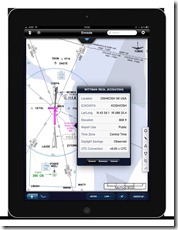
Jepp Mobile FliteDeck image 3FliteDeck includes own-ship position and route overlay and the ability to view the complete library of charts, diagrams, and Airway Manual Text. The digital data enables pilots to declutter charts, selecting the information they need to see, when they need to see it. A “scrubber” does the same for terminal charts. The “favorites” function provides quick, one-touch access to airport and en route charts.

At the media announcement, the Jepp rep made it clear that the app builds on the success of the Jeppesen Mobile TC for the iPad, and that FliteDeck is available for the general, business, commercial, and military aviation markets. He added that many operators will need FAA approval for in-flight use, a process that includes rapid decompression testing, which ASIG has successfully demonstrated.

Aspen’s Connected Panel Integrates Mobile Devices

Aspen Connected panelAspen Avionics demonstrated its new patent-pending line of Connected Panel hardware, software, and apps that employ two-way WiFi communication to seamlessly integrate aviation data from personal electronic devices with certificated avionics installed in the aircraft. This technology is enabled by Aspen’s Evolution Flight Displays, and it will be available at the end of 2011 through Aspen dealers.

The initial apps are in development for Apple iOS and Android platforms. They are based on an open hardware architecture and application programming interface. Connected Panel developers will have access to an open API with no licensing or royalty fees.

The Connected Panel hardware is a small, blind-mounted box, the CG100. It contains wireless, Bluetooth, and USB connections and flash memory storage. Employing commercially available technology, it features standard protocol ports and communication slots that will allow developers to add peripheral hardware to the CG100 as needed for their own applications.

Aspen Connected Pilot iPad app tuning w iPadConnected Pilot is the initial Connected Panel product. It includes the ability to tune radios and cross-fill flight plans from the iPad to the Bendix-King KSN 770, a GPS nav-com currently being developed by Honeywell and Aspen Avionics. ForeFlight will release a new version of ForeFlight Mobile with Connected Pilot capability that will enable pilots to plan flights on the iPad and load it into the KSN 770.

Aspen has been actively cultivating partnerships with those who will employ Connected Panel technology in new products of their own. They include AvConnect, Jeppesen, JP Instruments, Parrot, Pinnacle Aerospace, PS Engineering, Seattle Avionics, and Sporty’s Pilot Shop.

Avidyne Launches Plug & Play Touch-Screen Avionics

Avidyne touch screenAvidyne Corporation, long known for its glass panels, has launched a full-line of general aviation avionics. Available in 2012, they are plug & play replacements for other brands. Standing out is the IFD540 touch-screen FMS/GPS nav-com. The FMS meets TSO-C146c for full SBAS/LPV approach guidance and features one-touch airway and jet route navigation. Looking forward to the 2020 deadline imposed by NextGen, Avidyne’s new AXP340 Mode S plug & play transponder with extended squitter meets the NextGen ADS-B Out requirements. The transponder combines with the ADS-B In capable TAS600A Series Traffic Advisory System to complete NextGen capabilities.

HondaJet Natural Laminar Flow Wing

AV11-40In the Honda chalet was a huge metal panel obviously the product of a CNC mill. Covering its jeweled slightly concave surface was a grid of integral stiffeners. Milled from a single 2,500-pound billet of aluminum alloy, it was the top skin of the HondaJet’s natural laminar flow wing (NLF). With the ribs as part of the skin, the upper and lower panels essentially bolt to the spar, seriously reducing the parts count. With the rigid, smooth surface, Honda said the NLF delivers a high maximum lift coefficient, low profile drag, and reduced performance penalties due to leading edge bug contamination, a problem with conventional laminar flow airfoils.

Until next time, stay 5x5, mission ready, and Wired!

Monday, July 18, 2011

Paris Airshow Review: Buy New & Wait

Welcome to Wired!

All told, operators worldwide bought more than $100 billon worth of new airplanes from Airbus, Boeing, Embraer, and Bombardier at the 49th International Paris Air Show, held  June 20-26 at Le Bourget. The 660 orders for the single-aisle Airbus A320NEO (new engine option) fueled  speculation on whether Boeing would build new or re-engine its venerable 737.

Paris 49These sales reports surely result in  sleepless nights for those who operate late model and legacy transport category aircraft. So that you’ll sleep better, note that the news never fully addressed one aspect of buying new: delivery positions, and how many years operators had to wait for their new airplanes. Nor did reports mention inevitable delays and cost overruns.

When you get right down to it, operators buying new airplanes are really after just two things, efficient powerplants and modern avionics. Avionics is a supporting player at Paris, but L-3 Aviation Communication & Surveillance Systems announced a contract for its commercial NextGen/SESAR products in the new US Air Force’s Boeing 767 tanker.

In the flurry order-count reports, International Lease Finance  CEO Henri Courpron was the voice of pragmatic reason: “Does a child want a new toy? Of course. Everybody wants a new airplane, but there comes a time to ask the parental, adult questions [such as], ‘How much will it cost?’ and ‘Do we need it?’”

Given all this, ask yourself, “Why buy new and wait—and pay extra for the airframe you really don’t need—when ASIG can deliver what you want now?”  Avionics, IFE or other sensors and controls, it can meet your needs on your schedule at a cost far below that of new. By upgrading what you need now, you’ll reap the savings while others are awaiting for their number to come down the production line.

Until next time, stay 5x5, mission ready, and Wired!

Tuesday, July 5, 2011

Adopting Technology: Three Takes on COTS Electronic Flight Bags

Welcome to Wired!

[EFB-PR2[4].jpg]The benefits of using commercial off-the-shelf (COTS) tablets like the Apple iPad as electronic flight bags (EFBs) are easy to grasp. A typical pilot’s flight bag, filled with all the necessary manuals, charts, and other required documents weighs between 35 and 50 pounds, depending on each airline’s requirements.

An iPad or similar device holds all of it, and it weighs roughly 1.5 pounds. That translates to millions saved in fuel, paper, printing, distribution, revision time, and healthcare costs related to the contortions required to maneuver heavy flight bags in tight cockpits.

The challenge is how to adopt this new technology and integrate its use in an airline’s operations. It is not a one-size-fits all, as the paths taken by Alaska, American, and Southwest will show. As discussed in a previous issue of Wired, N-Jets, a Part-135 carrier, chose another route, in which ASIG guided it to the industry’s inaugural A061 iPad EFB approval in 2010

American is a cautious early adopter. According to the company, it was the first Part-121 carrier the FAA authorized to use iPad EFBs. By meeting the requirements collected in FAA InFO 11011, dated May 13, 2011, American can use the Class I EFB, which runs Jeppesen software and data and provides operational and navigation and approach information in all phases of flight.

With this approval, American started a test program with select crews. Boeing 777 pilots based at LAX are conducting the final testing of iPad as Class I EFBs. Upon satisfactory completion of these tests that prove the unit’s full operational and navigation capabilities, American will make the final decision on its integration, whether it will assign iPad EFBs to each pilot or each aircraft in its fleet.

Alaska Airline EFB Video from USA Today

Rather than phase in a fully capable EFB, Alaska Airlines has issued iPads with limited capabilities to all of its pilots. “The initial iPad deployment provides 20 company manuals, two checklists, and other pilot information files,” said Sarah Dalton, Alaska director of airspace and technology. Good Reader displays the documents. Pilots also have access to company websites and e-mail outside the aircraft.

Pilots now have access to information on and off the aircraft, she continued. They update this data through a secure company portal accessible from any WiFi Internet connection, and “a time-date stamp will appear next to the file when the synchronization process is complete.” This cost-effective technology saves the time and money associated with  about 2.4 million pieces of paper.

A Class I device is not approved for all phases of flight, Alaska crews must power down below 10,000 feet. To provide operational and navigation information during these phases of flight “We will be putting paper aeronautical charts on the aircraft directly rather than issuing them to each pilot,” said Dalton.

With the paper flight bag as the primary information source, the initial iPad deployment required no changes in the airline’s operating specifications, she said. “Ultimately we want to stop carrying paper and will need an operation specification to do that. To get to that point, all the pilots will need to be proficient on the iPad and the company updating process must function reliably . We anticipate that the operation specification will be in place in the late summer/early fall time frame.”

Once the iPad proves itself in this arena, Alaska will take the next step, either installing a Class II mount for the iPad and certifying it for full operational and navigational use in all phases of flight or integrating it with a traditional EFB.

Share the Spirit LogoSouthwest Airlines operates with “paper flight bags that are aircraft-centric, not pilot-centric,” said Chief Operating Officer Mike Van de Ven. Because pilots vastly outnumber airplanes, this efficiently reduces the pages it must create, distribute, and revise. Southwest has been studying and evaluating iPad technology as it matures, but it does not now have an active EFB program.

The pluses are clear, he said, but so are the minuses. “I’m not sure that the process is reliable, and you’ve got the investment in technology that needs to be on the airplane, and whether it would be with the pilot or the airplane.” Pilots often need several documents at the same time, which means they would have to flip to them because the iPad cannot display more than one readable document at a time.

Given these nuances, the iPad “is an interesting and advancing piece of technology,” said Van de Ven, but “I’m not sure that at this stage of development that it produces a substantial improvement over the way we operate today.” But he clearly recognizes that “the technology is moving so fast in that area that what I say today may or may not be true a year and half from today, or even next month.”

In other words, the imperative is that airlines need to keep current with the latest developments in all aspects of aviation technology to fully evaluate how they may benefit their operations. That includes putting the technology to work. As ASIG learned with N-jets certification effort, stepping up required the development and integration of FAA-compliant, thermal mitigating, iPad-compliant external power supplies, Class II mounting solutions, and custom software apps that meet the operator’s needs.

Until next time, stay 5x5, mission ready, and Wired!